Buyer's guide
Power Pre-Stretch vs Mechanical Brake: The Pallet Wrapper Decision That Drives Your Film Bill
Power pre-stretch vs mechanical brake is the single specification choice that decides what your stretch film bill looks like next year. Whittaker Packaging Solutions (WPS) walks every buyer through it before recommending a pallet wrapper, because the wrong call here can cost 30-50% more in film per year than the right one.
This page is the plain-English version of that conversation, with the technical detail underneath for procurement and production managers who need the numbers.
The short version
The short version
A mechanical brake carriage is the entry-level film delivery system. A friction brake holds the film roll, and as the turntable rotates that brake creates tension that stretches the film slightly as it wraps. How much depends on the brake setting and load shape. Typical real-world elongation: 20-50%.
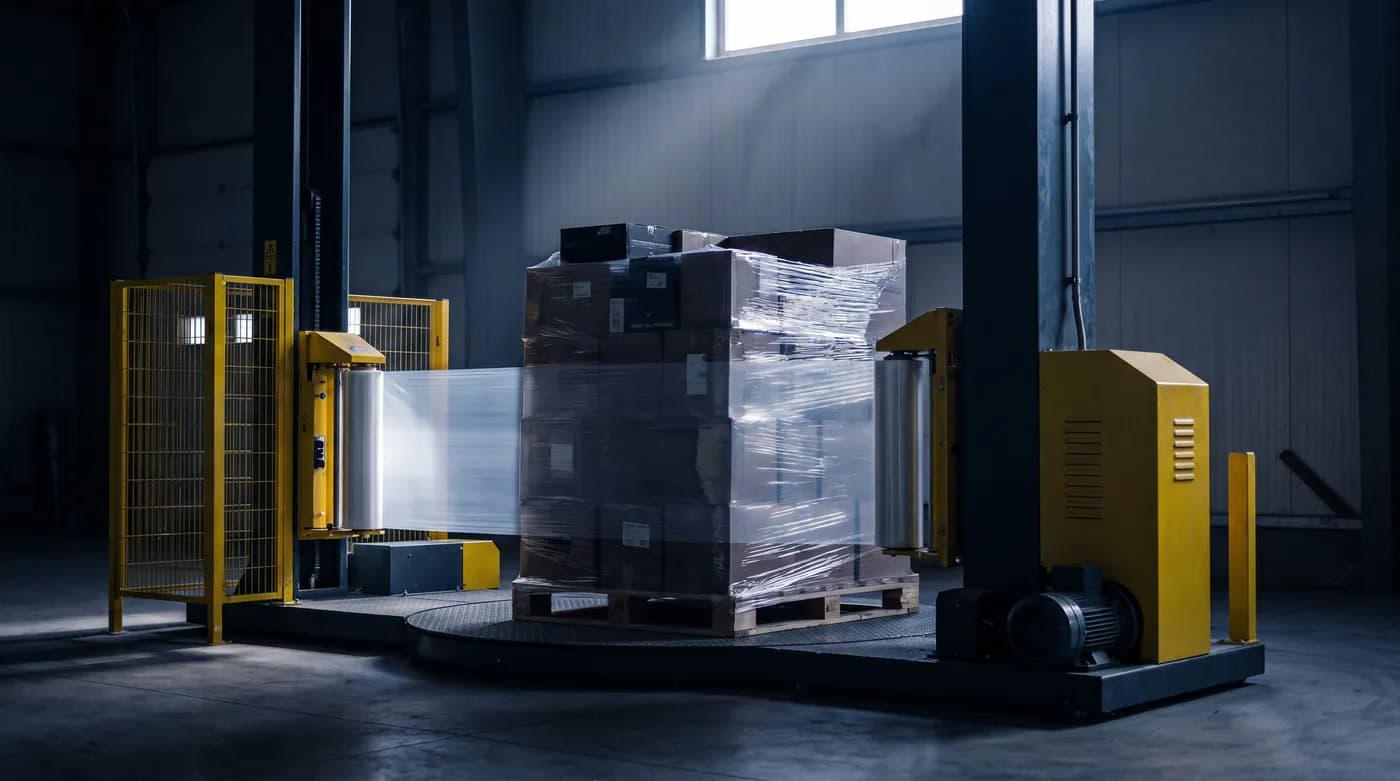
A power pre-stretch carriage uses two motor-driven rollers spinning at different speeds. The film passes between them and is stretched mechanically before it ever touches the load. Typical elongation: 200-250%, sometimes higher.
In plain terms: with mechanical brake, one metre of film becomes about 1.2-1.5 metres on the pallet. With power pre-stretch, one metre of film becomes about 3-3.5 metres on the pallet. That difference is your film bill.
What that means in dollars
Most Australian warehouses wrap between 20 and 200 pallets a day and use 150 to 400 grams of film per pallet. Film type matters (gauge, polymer blend, machine grade vs hand grade), but the directional maths is consistent: switch from a mechanical brake unit to a properly tuned power pre-stretch unit and your film weight per pallet typically drops by 35-55%.
For a site wrapping 50 pallets a day, that's thousands of dollars a year in film savings. For a high-volume site running 150+ pallets a day across multiple shifts, the annual film saving alone often covers the price gap between an entry wrapper and a power pre-stretch unit inside 12-18 months.
The WPS team will run those numbers against your current film spend before recommending a machine. Use our film consumption calculator for a self-serve starting point.
How mechanical brake works
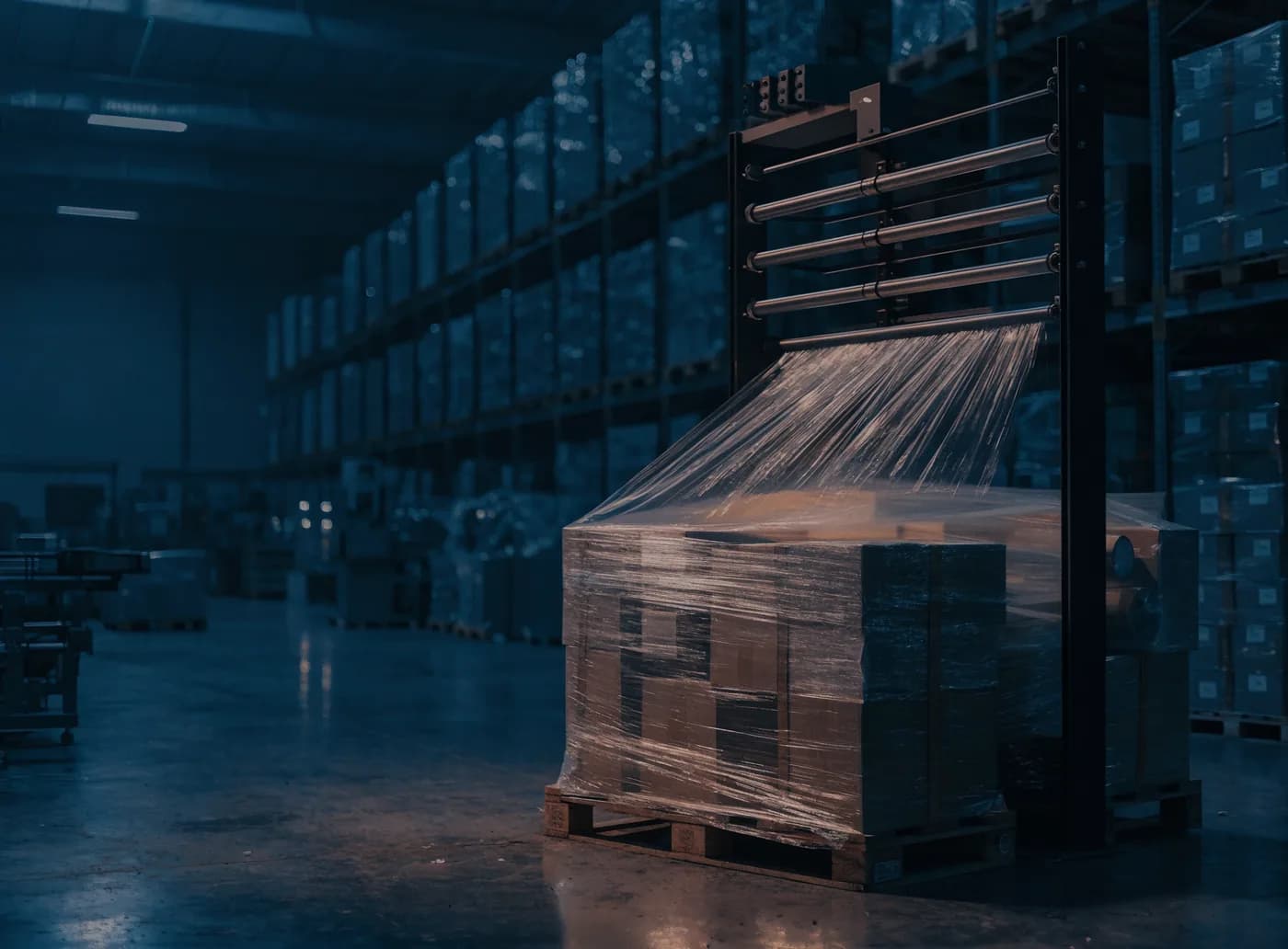
A mechanical brake film carriage holds the film roll on a spindle with an adjustable friction brake. As the turntable pulls film off the roll, the brake resists the unwind, creating tension between roll and load that stretches the film as it goes on.
Mechanical brake strengths
Simple mechanically.
Fewer parts, fewer failure modes.
Low capital cost.
Entry-level machines sit at the bottom of the price range.
Forgiving of poorly trained operators.
Brake-tension issues show up as loose wraps, not film breaks.
Mechanical brake weaknesses
Low stretch ratio. Typical elongation 20-50%.
Film cost dominates total cost of ownership at any meaningful volume.
Tension is set by operator feel, not by specification. Two operators get two different wrap qualities.
Films designed for power pre-stretch don't work well on a brake unit. You are locked into a narrower (and usually more expensive per metre) film range.
Mechanical brake is the right answer for low-volume sites, occasional users (under 10 pallets a day), and businesses where the wrapper is genuinely a secondary tool.
How power pre-stretch works
A power pre-stretch carriage uses two geared rollers driven by an electric motor. The film passes between them, and because the second roller spins faster than the first, the film is stretched by a controlled, repeatable ratio before it leaves the carriage.
Common pre-stretch ratios
150%
the first roller moves 1 m, the second roller moves 2.5 m
200%
1 m to 3 m
250%
1 m to 3.5 m
300%
on some heavy-duty units
The stretched film is then applied to the load at a controlled force-to-load (the inward pressure the wrapped film exerts on the pallet). Force-to-load is set on the machine, not by the operator. That makes wrap quality repeatable from shift to shift.
Power pre-stretch strengths and weaknesses
Strength Film economy. The single biggest reason to specify power pre-stretch.
Strength Repeatable, controllable wrap force-to-load.
Strength Compatible with thinner machine-grade films designed for high pre-stretch.
Strength Better load containment on stable loads at the same film weight.
Weakness Higher capital cost.
Weakness More moving parts in the carriage (gears, motor, rollers).
Weakness Requires correct film selection. The wrong film breaks at 250% pre-stretch.
Weakness More sensitive to operator training and machine setup.
Pre-stretch ratio vs force-to-load: don't confuse them
Pre-stretch ratio and force-to-load are two different things, and confusing them is the most common buyer mistake the WPS team sees.
Pre-stretch ratio is how much the film is stretched before it touches the load. Higher pre-stretch = more film coverage per metre = lower film cost.
Force-to-load is how tightly the stretched film grips the load. Higher force-to-load = more containment force = more stable load in transit.
A good power pre-stretch unit lets you set both independently: high pre-stretch with moderate force-to-load for fragile loads, or high pre-stretch with high force-to-load on hardy loads that need maximum containment.
A mechanical brake unit gives you neither setting cleanly. You get one tension value, set by operator feel.
When mechanical brake is still the right answer
The WPS team will tell you when an entry-level mechanical brake unit is the right call. Honest cases:
You wrap fewer than 10 pallets a day on average
The wrapper is a back-up to manual hand-wrapping, not your main wrap method
Your loads are short, light and visually stable (so loose wraps don't matter)
You have no path to a higher-volume application in the next 3 years
Outside those cases, the maths favours power pre-stretch.
Service coverage
Whittaker Packaging Solutions provides full service, preventative maintenance and breakdown support across South East Queensland, Toowoomba and Melbourne. Typical breakdown response is 24-48 hours during business hours, especially in our key service hubs. Power pre-stretch carriages benefit from a preventative maintenance schedule (gear inspection, roller cleaning, drive belt check) to maintain stretch ratios over time.
Talk to us before you choose
Send us your current film spend, pallets-per-day average, and the film type you use. We'll run the maths against a power pre-stretch unit and tell you honestly which one stacks up commercially. If finance makes the upgrade work, we'll walk you through the options.
FAQs
Common questions
Power pre-stretch uses two motorised rollers to elongate the film mechanically (typically 200-250%) before it reaches the load. Mechanical brake holds the film roll with a friction brake, achieving lower stretch (typically 20-50%) by film tension alone. Power pre-stretch dramatically cuts film cost per pallet.
Keep reading