Buyer's guide
How to Choose a Pallet Wrapper: A Practical Buyer's Guide from Whittaker Packaging Solutions
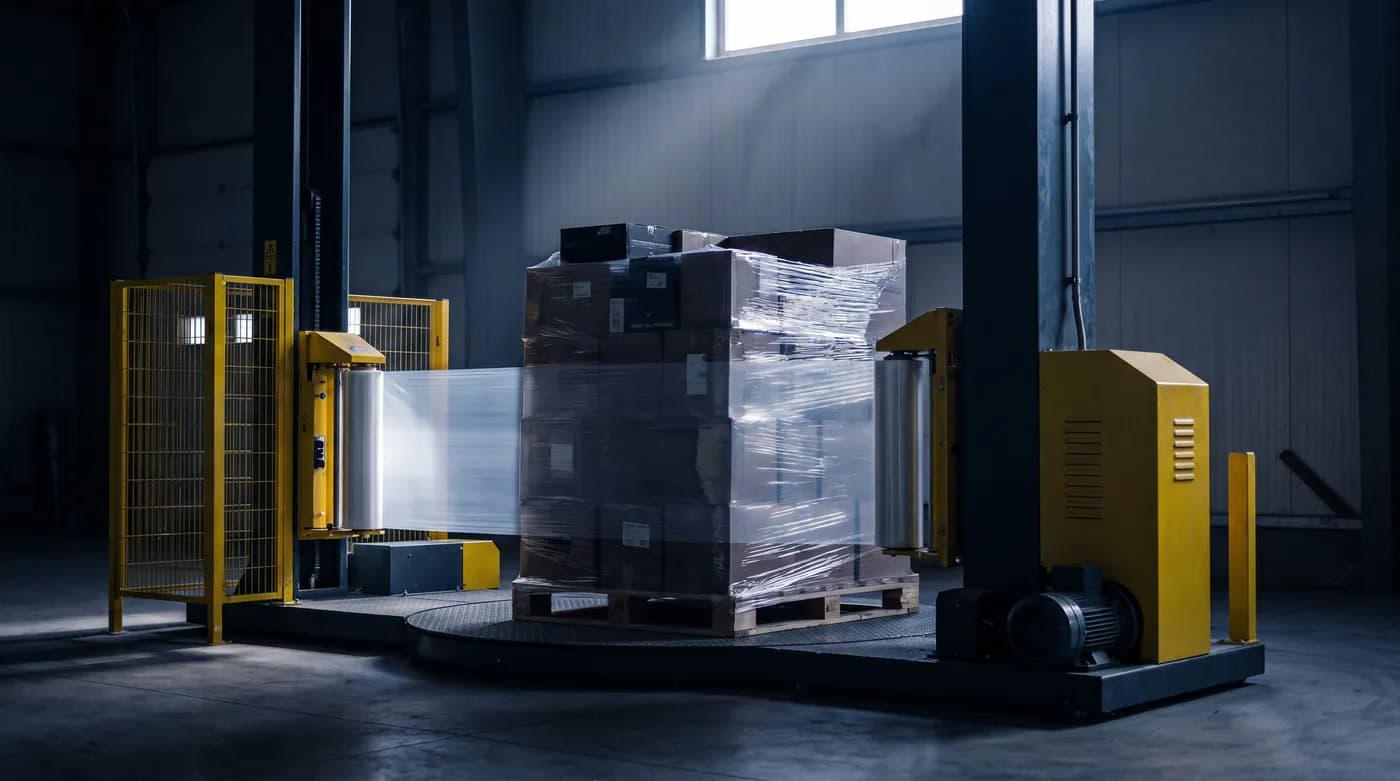
How to choose a pallet wrapper is a question Whittaker Packaging Solutions (WPS) gets weekly, usually from someone who knows they need a wrapper but isn't sure which one. This page walks through the questions we ask before recommending a machine, in order. Answer them honestly, send us your responses, and we'll come back with a configured spec sheet and a price.
The principle behind this guide: the right pallet wrapper is the one that suits your load, your throughput and your floor. The cheapest one is often the most expensive over five years. The most expensive one is often more machine than you need.
Question 1
How many pallets per day do you wrap?
This is the headline number. Be honest about the average AND the peak. A site that averages 30 pallets a day but hits 80 on Mondays needs a machine that handles the Monday peak, not the average.
Under 10 per day
a basic semi-automatic with mechanical brake is usually fine. Spend the money you save on better film.
10-30 per day
semi-automatic with power pre-stretch. The film savings pay for the upgrade quickly.
30-80 per day
semi-automatic with power pre-stretch is still in range, especially if you have a forklift driver who naturally cycles past the wrapper. Above 60, start looking at fully automatic.
80-200 per day
fully automatic pallet wrapper, integrated with a conveyor where possible.
200+ per day
fully automatic ring-style or rotary-arm wrapper, inline with the production line.
Question 2
What is the maximum weight of your pallets?
The turntable rating matters. A 2,500 kg load on a 1,500 kg-rated turntable wears bearings and motors faster than the warranty allows, even if it appears to work day to day.
Up to 1,500 kg standard turntable rating, most machines suit.
1,500-2,500 kg heavy-duty turntable required, or rotary-arm wrapper.
Above 2,500 kg rotary-arm or robotic wrapper. A turntable is the wrong format here.
Question 3
What is the maximum height of your pallets?
The mast height on a pallet wrapper sets the maximum wrappable load height. Standard masts handle 2,400 mm. Extended masts handle 2,700-3,000 mm.
Up to 2,000 mm any standard mast.
2,000-2,400 mm standard mast (verify the actual wrap height, not just total mast height).
2,400-2,700 mm extended mast required.
Above 2,700 mm extended mast plus careful spec of the load detection.
Question 4: What are your minimum AND maximum pallet dimensions?
The maximum tells us the turntable diameter or rotary-arm reach you need. The minimum matters too: very small loads need the film attach configured for them, and the wrap cycle programmed to deliver enough wraps without wasting film.
If you wrap a mix of standard 1165x1165 mm Australian pallets and small 600x800 mm trolley loads, we'll tell you whether one machine handles both economically or whether you need two wrap stations.
Question 5
How do you load the wrapper?
The loading method changes the deck configuration.
Forklift a low-profile turntable on the floor works. Forklift tines slide off the pallet cleanly.
Electric pallet jack you need either a recessed pit-mounted turntable (flush with the floor) or a ramp onto a low-profile deck. Without one of those, the pallet jack can't get under the pallet to unload.
Hand truck / pump trolley same as electric jack. Ramp or recessed pit.
Question 6: Do you need a ramp?
Direct follow-on from Question 5. If you load with anything other than a forklift, the answer is yes, unless you have a recessed pit installation. Ramps are an add-on to the standard machine and add to footprint. Plan for it during scoping, not after install.
Question 7
Do you need integrated scales?
Some warehouses need to capture pallet weight at the wrap station for shipping documentation. The wrapper turntable can include integrated scales accurate enough for most non-trade applications. If you need legally tradeable weight (for selling by weight), that is a separate certified scale conversation.
No weight capture needed skip the scales option, save money.
Internal weight capture for shipping/manifests turntable scales suit.
Legally tradeable weight separate certified weighing setup; talk to us.
Question 8
What product are you wrapping?
Product type drives the wrap pattern and the carriage choice.
Stable boxed product (FMCG cartons, beverage) standard wrap pattern, power pre-stretch saves film.
Bagged product (rice, flour, animal feed) shifting risk; specify soft-start rotation, corner roping, and dwell time at the bottom of the load.
Drum or IBC loads top sheet often needed; consider rotary-arm if loads are very heavy.
Stacked unstable loads rotary-arm or robotic; spinning unstable loads on a turntable causes failures.
Cold-store product machine must be rated for the temperature; specify cold-room hardware (sealed bearings, cold-rated lubricants).
Wet or wash-down area stainless trim and IP-rated electrics.
Outdoor or yard use weather-rated unit; standard wrappers don't last outdoors.
Question 9
What is your operating environment?
Tied to Question 8 but worth its own answer. The environment determines machine specification more than people expect.
Cold room (chilled, frozen) cold-rated machine.
Wet / wash-down area IP-rated electrics, stainless components.
Outdoor weather-rated, possibly canopy.
Polished concrete floor (clean warehouse) any standard machine.
Rough or uneven concrete turntable preferred; mobile robotic units don't track well on rough surfaces.
Question 10: What is your film budget today?
This question decides whether the upgrade to power pre-stretch pays back fast. Tell us your current monthly film spend and film type, and we can run a like-for-like saving estimate against a quality power pre-stretch unit. See our power pre-stretch vs mechanical brake guide for the maths, and the film consumption calculator for a self-serve estimate.
Service coverage matters as much as the machine
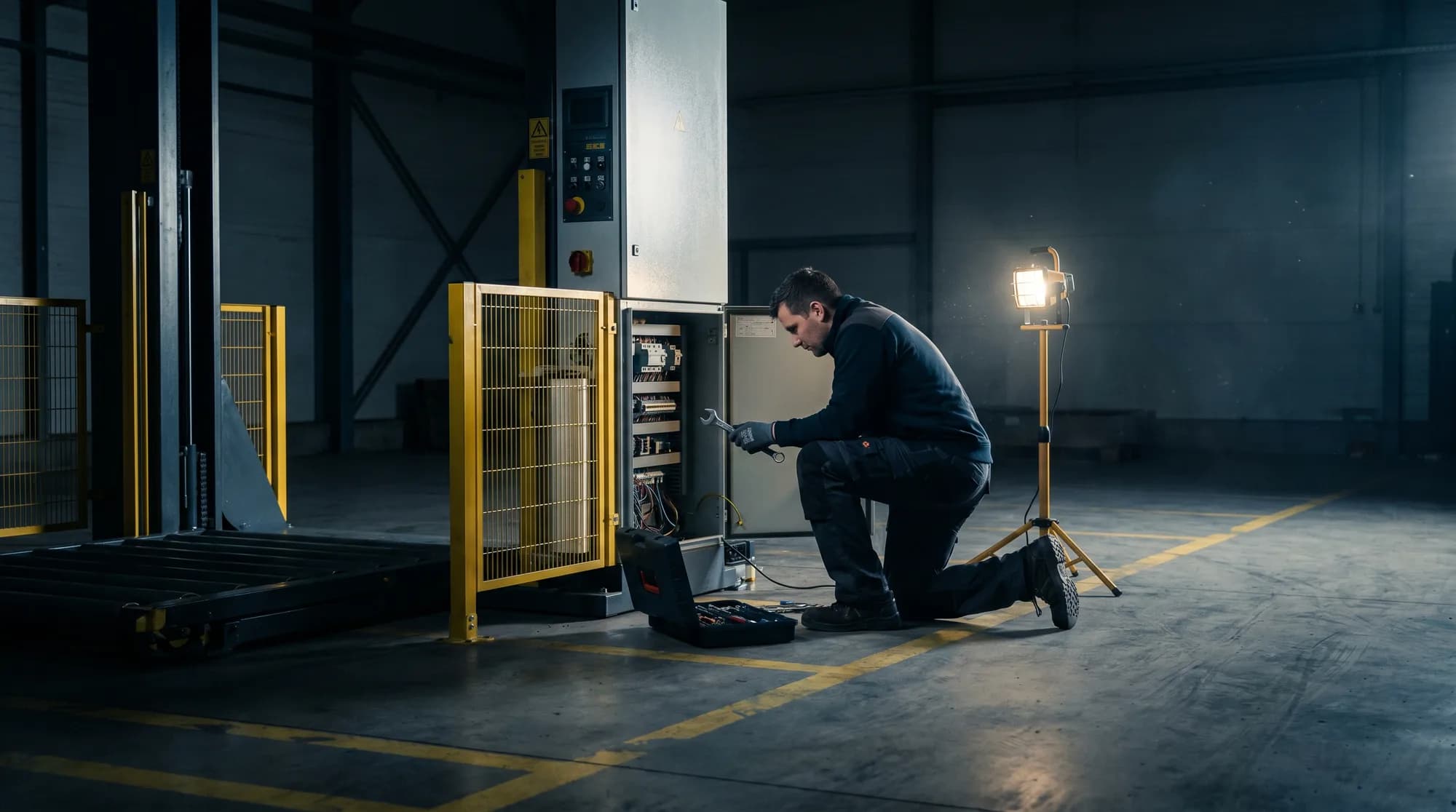
Whittaker Packaging Solutions provides full service, preventative maintenance and breakdown support across South East Queensland, Toowoomba and Melbourne. Typical breakdown response is 24-48 hours during business hours, especially in our key service hubs.
In Northern NSW and Regional QLD (Roma, Bundaberg), we supply and deliver machines and run scheduled or FIFO service visits where it fits. If your site is well outside a major service hub, factor that into the machine choice. A simpler machine with locally available parts often beats a sophisticated one that needs a specialist on site.
Send us your answers
The quickest way to a recommendation is to send us your answers to the ten questions above. We'll come back inside business hours with a configured spec sheet, a film-cost projection and a quote.
FAQs
Common questions
Answer the ten questions on this page (pallets per day, max weight, max height, dimensions, loading method, ramp need, scales need, product type, environment, current film spend) and send them to the Whittaker Packaging Solutions team. We come back with a configured spec sheet and a film-cost projection.
Keep reading