
Knowledge base
Strapping Tool Buyer's Guide: Battery vs Pneumatic, PET vs PP, Manual vs Automatic
This Whittaker Packaging Solutions strapping tool buyer's guide covers the three decisions that determine whether your strapping setup helps or hurts your operation. Battery or pneumatic. PET or PP. Manual, semi-auto or auto. Get those three right and the rest of the conversation gets easy.
It is written for operations managers at FMCG, logistics and manufacturing sites, and owner-operators stepping up from a hand tensioner. The WPS team has specified strapping equipment since September 2020, with roughly 70 years of combined experience behind the recommendations.
Pricing depends on strap grade, tensioning spec and accessory kit, so this guide uses generic comparison framing against typical mid-tier imported machines.
Decision one
Battery vs pneumatic strapping tools
Battery strapping tools are the right answer for most modern Australian operations. Pneumatic tools still have a place, but the gap has closed materially in the last five years.
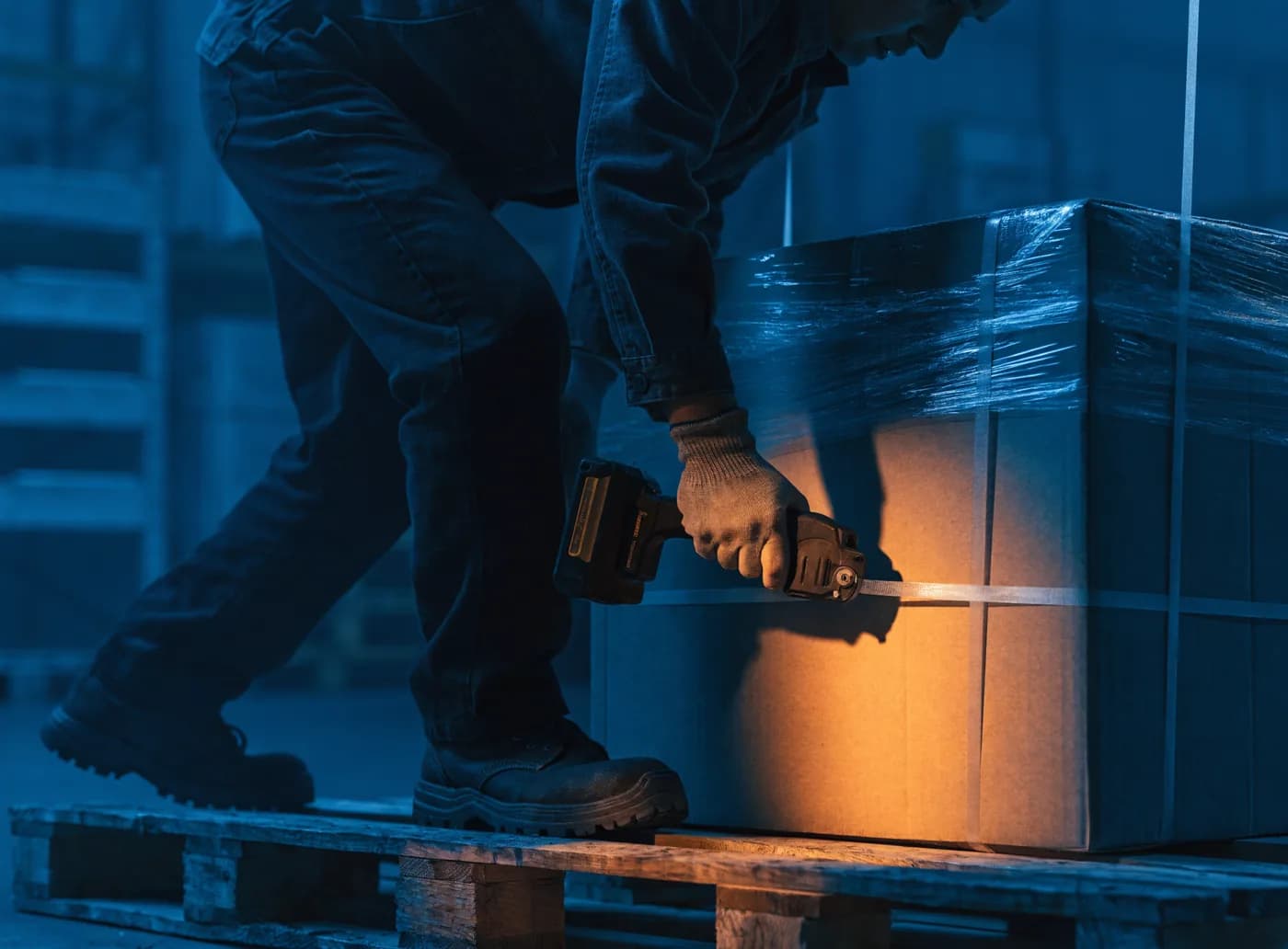
Battery tools run on lithium-ion packs, are fully portable, and need no air line or compressor. They tension, seal and cut PET or PP strap in a single trigger cycle, and the good ones produce a consistent joint without operator skill. Quieter on the floor, safer for staff moving between pallets, and no compressor running cost.
Pneumatic tools run on compressed air, deliver continuous duty cycles without battery swaps, and stay sensible on sites with existing high-capacity air infrastructure. They tie the operator to an air line, a real ergonomic consideration on multi-pallet shifts.
Compared to typical mid-tier imported pneumatic tools, a modern battery tool usually wins on portability, joint consistency and total cost of ownership when compressor electricity and maintenance are included. The exception is very high duty-cycle bench operations where a tethered air tool never moves.
Decision two
PET vs PP strapping
The strap you run drives the tool you need. The two strap families are not interchangeable.
PET (polyester) is the higher-performance plastic option. High tensile strength, low elongation, holds tension over time. Right for palletising heavy or shifting loads, bricks, timber, steel coil and long transit. Replaces steel strap in many applications because it is safer for staff and does not corrode. Needs a tool that produces a friction-weld or heat-seal joint.
PP (polypropylene) is lighter, cheaper per metre and easier to apply, well suited to cartons and light pallet tie-offs. It loses tension faster than PET, so wrong for long-haul or heavy shifting loads. Most box-strapping machines run PP by default.
Rule of thumb: if the load can shift in transit and damage matters, you are on PET. If you are bundling cartons for short dispatch, you are on PP.
Decision three
Manual, semi-automatic or fully automatic
The third decision is about volume and operator economics, not about machine sophistication.
Manual tools are handheld battery or pneumatic units. The operator brings the tool to the strap, threads, tensions, seals and cuts. Manual suits low to moderate throughput, pallets that move around the floor, and anywhere strap goes on in awkward positions or non-standard load shapes. A modern battery tool is fast in a trained operator's hands.
Semi-automatic machines are typically table-top or arch units. The operator places the load and positions the strap, and the machine tensions, seals and cuts. Semi-auto suits carton bundling, light pallet operations and any setup with a consistent load profile and an operator already at the station. Throughput per shift goes up materially over a handheld tool, and joint consistency is no longer operator-dependent.
Fully automatic machines integrate with a conveyor and apply straps without operator intervention. The load enters, the machine straps it, the load leaves. Right for high-volume, repetitive carton or pallet operations where the labour saving justifies the capital. Wrong for variable load profiles, low volumes or sites without conveyor infrastructure.
A common mistake. Sites jump from manual to fully automatic and skip the semi-auto step. In many operations, a well-specified semi-auto unit delivers most of the throughput benefit at a fraction of the capital cost.
How to think about cost vs efficiency
Total cost is the sum of tool capital, strap consumables, joint failure rate, operator time per cycle, compressor or charging infrastructure, and maintenance over the tool's life. Compared to a typical mid-tier imported handheld pneumatic tool, a modern battery PET tool often cuts operator time and joint failure enough to outweigh its higher capital cost. The reverse is true on a fully automated PP carton line, where throughput per operator dominates.
The WPS team works through the version of this calculation that applies to your operation. Usually a 20-minute phone call.
What to bring to a strapping tool conversation
The faster you can give us these answers, the faster we can recommend the right tool.
Strap type currently in use (PET or PP) and gauge.
Loads per shift and shift count per day.
Load profile: cartons, light pallets, heavy pallets, mixed.
Current tool make and age, or current method (hand tensioner, table-top, automatic).
Compressor capacity and condition on site (if pneumatic is in play).
Operator turnover rate (because joint consistency matters more on high-turnover sites).
Transit profile of the strapped load: short, medium, long, multi-modal.
If you have this in your head, a phone consultation usually closes out the recommendation.
Talk to the WPS team
For a recommendation tailored to your operation, request a spec sheet and tell us the basics in the form. The WPS team responds within 24-48 hours during business hours, especially in our key service hubs.
FAQs
Common questions
The strapping tool buyer's guide covers the three decisions that determine the right tool for your operation: battery vs pneumatic, PET vs PP, and manual vs semi-automatic vs fully automatic. It also covers how to think about total cost and what to bring to a phone consultation.